



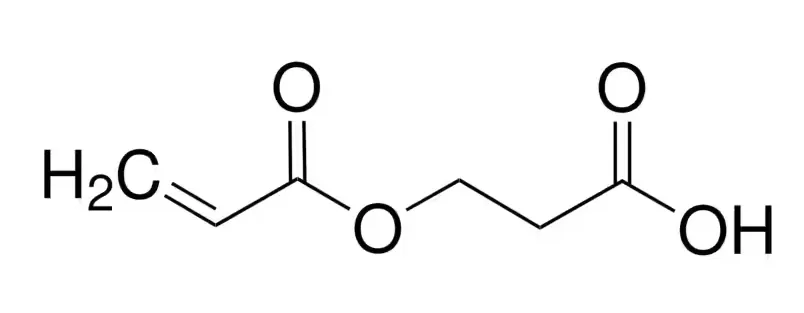
2-Carboxyethyl acrylate CAS 24615-84-7
Identification
CAS Number
24615-84-7
Name
2-Carboxyethyl acrylate
Synonyms
3-prop-2-enoyloxypropanoic acid
SMILES
C=CC(=O)OCCC(=O)O
StdInChI
InChI=1S/C6H8O4/c1-2-6(9)10-4-3-5(7)8/h2H,1,3-4H2,(H,7,8)
StdInChIKey
CYUZOYPRAQASLN-UHFFFAOYSA-N
Molecular Formula
C6H8O4
Molecular Weight
144.13
MDL Number
MFCD00040709
Properties
Appearance
Transparent liquid
Density (25℃, /cm³)
1.194
Boiling point 19mmHg
103℃
Safety Data
Symbol
 GHS05
Signal Word
Danger
Hazard statements
H314Precautionary Statements
P280 – P301 + P330 + P331 – P303 + P361 + P353 – P304 + P340 + P310 – P305 + P351 + P338 – P363Personal Protective Equipment
dust mask type N95 (US), Eyeshields, Gloves
RIDADR
NONH for all modes of transport
WGK Germany
3
Specifications and Other Information of Our 2-Carboxyethyl acrylate CAS 24615-84-7
Color number (APHA)
≤200
Viscosity (25ºC, CPS)
70-80
PH (10% aqueous solution)
1
Water solubility ratio
1:1
Acid value (MEQ/g)
6.4-7.0
Inhibitor MEHQ (ppm)
500-800
Water content Karl Fischer method
≤1%
Tg (℃)
37
Functionality
1
Shelf Life
2 years
Packaging
25KG/200KG/barrel
Storage
To prevent the product from being highly active and causing polymerization and gelling reactions, please seal and store it away from heat sources and sunlight. The recommended storage temperature is not higher than 30°C. Unused products must be sealed and stored in time and cannot be stored open. At room temperature of 25°C and ventilation, the safe storage period is 6 months.
Product Performance
β-Carboxymethyl acrylate is a reactive acrylic double bond that is easy to copolymerize with vinyl and acrylic monomers in emulsion polymerization and radiation curing systems. It has a low glass transition temperature and can effectively promote adhesion and improve the stability of the emulsion. It has a long side carboxylic acid chain that gives good flexibility, which promotes more effective interaction between the polymer and the substrate, thereby enhancing adhesion and peel strength. This strength tends to increase with time. β-CEA undergoes cross-linking reactions with structures such as amino, hydroxyl, epoxy, and isocyanate functional groups. It is applicable to water-based, solvent-based, and 100% solid systems. It has a low Tg value (37°C) and can be used to adjust the hardness of coatings or improve the bonding strength of pressure-sensitive adhesives.
Application characteristics
Powerful and widely applicable, commonly used as UV adhesive adhesion enhancer, active diluent monomer; giving laminating adhesive products excellent repeated adhesion; improving the bonding strength of pressure-sensitive adhesives as an adhesion promoter; significantly improving the adhesion of polyurethane baking paint systems, and improving the adhesion and peeling strength of surfaces with polar functional groups.
Known Application
Wide application range, applicable to many products. Used as an excellent active diluent in UV curing coatings, adhesives, and ink systems to improve adhesion. Used as a special monomer for emulsion polymerization, adhesives, and coating resin production.
Links
This product is developed by our R&D company Watson International Ltd (https://www.watson-int.com/).