


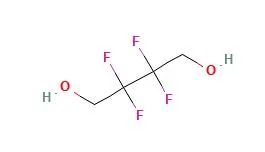
2,2,3,3-Tetrafluoro-1,4-butanediol CAS 425-61-6
Identification
CAS Number
425-61-6
Name
2,2,3,3-Tetrafluoro-1,4-butanediol
Synonyms
1,4-Butanediol, 2,2,3,3-tetrafluoro-
[Index name – generated by ACD/Name]
2,2,3,3-Tetrafluor-1,4-butandiol
[German]
[IUPAC name – generated by ACD/Name]
2,2,3,3-Tetrafluoro-1,4-butanediol
[IUPAC name – generated by ACD/Name]
2,2,3,3-Tétrafluoro-1,4-butanediol
[French]
[IUPAC name – generated by ACD/Name]
2,2,3,3-Tetrafluorobutane-1,4-diol
2,2,3,3-Tetrafluorobutanediol
Tetrafluoro-1,4-butanediol
SMILES
OCC(F)(F)C(F)(F)CO
StdInChI
InChI=1S/C4H6F4O2/c5-3(6,1-9)4(7,8)2-10/h9-10H,1-2H2
StdInChIKey
CDZXJJOGDCLNKX-UHFFFAOYSA-N
Molecular Formula
C4H6F4O2
Molecular Weight
162.082
MDL Number
MFCD00042375
Properties
Appearance
White solid
Safety Data
Personal Protective Equipment
Eyeshields, Gloves, type N95 (US)
WGK Germany
3
Specifications and Other Information of Our 2,2,3,3-Tetrafluoro-1,4-butanediol CAS 425-61-6
Identification Methods
HNMR, HPLC
Purity
98% min
Metal Impurities
≤500ppb
Shelf Life
2 years
Storage
Under room temperature away from light
Known Application
1.Fluorinated Polyurethanes : Used as a functional building block in the synthesis of segmented polyurethanes and perfluoropolyether-modified polyurethanes. 2.Fluorinated Polyesters and Specialty Polymers : Serves as a difunctional monomer or intermediate for introducing fluorinated segments into polymer structures. 3.Electronic Materials Development : Potentially suitable as a high-purity intermediate for developing specialty fluorinated polymers, functional coatings, and other advanced materials for electronic applications, subject to application-specific validation.
Key Advantages
1.High Chemical Purity : Helps minimize interference from unwanted components during synthesis and polymerization. 2.Fluorinated Molecular Structure : The presence of difluorinated carbon units provides opportunities to tailor surface properties, chemical resistance, and other material characteristics. 3.Two Reactive Hydroxyl Groups : Enables incorporation into polymer backbones through suitable polymerization and functionalization reactions. 4.Low Metal Impurities : When supported by analytical data, low metal contamination can help meet the purity requirements of electronic-material synthesis. 5.Low Moisture Content : Controlled water content helps improve process consistency in moisture-sensitive reactions. 6.Consistent Quality : Tight control of purity and impurities supports reproducible synthesis and stable downstream material performance.
Links
This product is developed by our R&D company Watson International Ltd(https://www.watson-int.com/).