



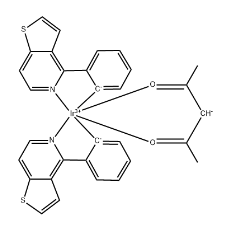
PO-01 CAS 1258323-36-2
- Identification
- Properties
- Safety Data
- Specifications & Other Information
- Links
Identification
CAS Number
1258323-36-2
Name
PO-01
Synonyms
Bis(4-phenyl-thieno[3,2-c]pyridinato-C2,N)(acetylacetonato)iridium(lll)
SMILES
CC(C)(C)C1=CC(=C(C(=C1)Br)O)C=NC2CCCCC2N=CC3=C(C(=CC(=C3)C(C)(C)C)Br)O.N#[Mn]
StdInChI
InChI=1S/C28H36Br2N2O2.Mn.N/c1-27(2,3)19-11-17(25(33)21(29)13-19)15-31-23-9-7-8-10-24(23)32-16-18-12-20(28(4,5)6)14-22(30)26(18)34;;/h11-16,23-24,33-34H,7-10H2,1-6H3;;
StdInChIKey
BCASYVRKVOPZJS-UHFFFAOYSA-N
Molecular Formula
C28H36Br2MnN3O2
Molecular Weight
661.3
Properties
Appearance
Orange to red Solid
Safety Data
RIDADR
NONH for all modes of transport
Specifications and Other Information of Our PO-01 CAS 1258323-36-2
Identification Methods
HNMR, HPLC
Purity
99% min
Shelf Life
1 year
Storage
Under room temperature away from light
Known Application
It is an organic iridium complex that is commonly used in the field of organic light-emitting diodes (OLEDs), especially in the application of phosphorescent materials. The following are its main uses:OLED luminescent materials:
1. This iridium complex is a phosphorescent emitter and is used as a red or orange light emitting material in OLED displays and lighting devices.Iridium complexes are widely used in next-generation display technologies such as high-end TVs, smartphone screens, and flexible displays due to their high efficiency, long life, and excellent luminescent properties.
2.Light-emitting layer materials:The coordination effect of its ligand structure and the central iridium ion enables it to produce efficient phosphorescent emission under low-energy excitation, which helps to improve the photoelectric conversion efficiency of OLED devices.By adjusting the chemical structure of the ligand, its emission wavelength and luminescent efficiency can be optimized, making it suitable for different display and lighting applications.
3. Other potential applications:Such iridium complexes may also be used in organic optoelectronic materials such as organic photovoltaic cells (OPVs) and organic field effect transistors (OFETs) to improve the performance of the device.
Links
This product is developed by our R&D company Watson International Ltd (https://www.watson-int.com/).